
Drawing Ideas Generator
Stuck staring at a blank page? Press the button for a random drawing idea — a subject, what it is doing, where, and a creative twist such as “using only three colours” or “from a bird’s-eye view”. Lock the parts you like and reroll the rest, start a timer for a quick sketch, or generate a whole 30-day challenge list to print.
- Free to use
- No sign-up
- Runs in your browser
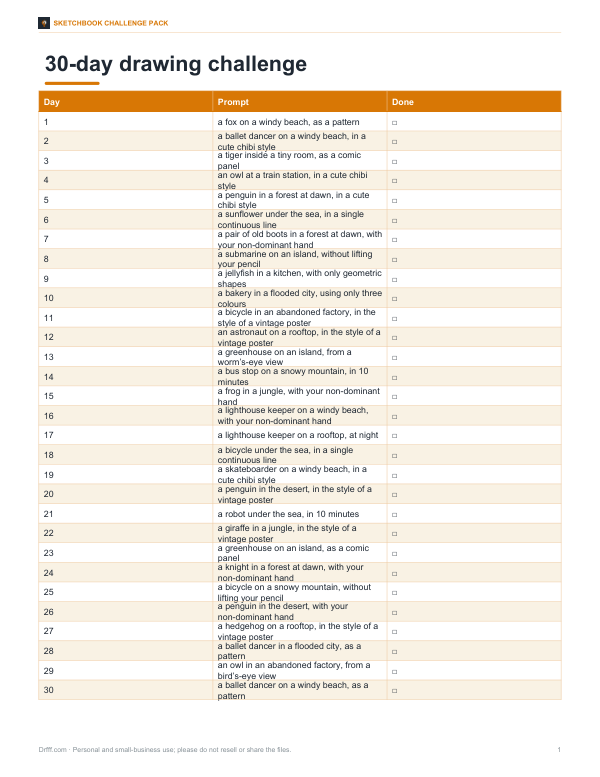

Drawing ideas generator
Sketchbook Challenge Pack
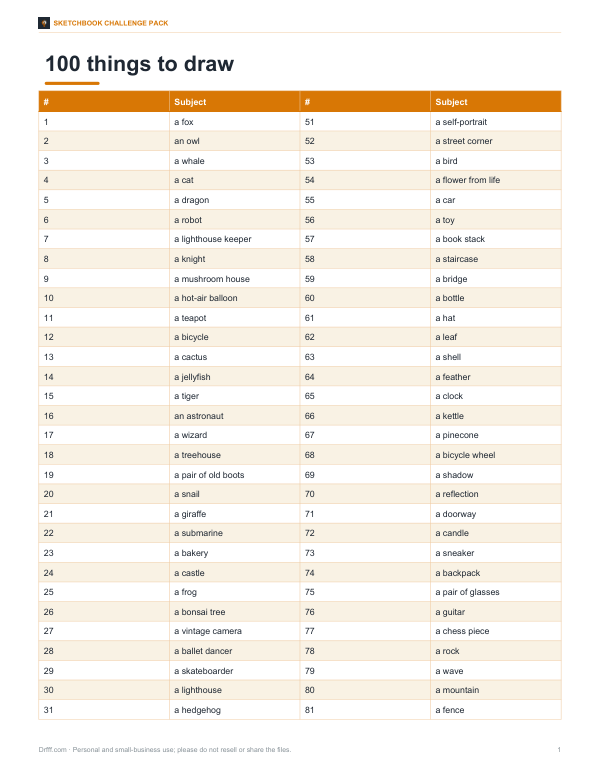
Printable 30-day and 100-day drawing challenge sheets, thumbnail sketch templates, a value scale and colour palette worksheet, and a sketch habit tracker.
- 30-day challenge (PDF)
- 100-day list (PDF)
- Thumbnail template (PDF)
- Value scale worksheet (PDF)
- Habit tracker (PDF, DOCX, XLSX)
Formats: PDF, DOCX, XLSX. Instant download after payment (link valid 72 hours, up to 5 downloads). AI-assisted: the templates were drafted with AI help and reviewed and laid out before publishing.
$3.00 USD, one-time 5 files · about $0.60 each
- Instant download
- 7-day refund
- Secure checkout by Stripe
7-day money-back guarantee. Full refund within 7 days of purchase, even after you download.
Free sample: 100 Day Subject List (PDF, 93 KB)
Full refund within 7 days — see the refund policy and license.
Free printables
Single sheets you can print right now, no sign-up. The full pack adds every sheet in one download plus the editable files.
 Printable Value Scale Worksheet
 Printable Sketch Habit Tracker
How the generator works
Each idea combines four parts chosen at random from curated lists: a subject (36 options, from animals and characters to objects and buildings), an action (20 options), a setting (18) and a creative twist (16) that changes how you draw — a limited palette, an unusual viewpoint or a time limit. That gives more than 207,360 combinations. Lock any part you like and press New idea to reroll the rest, or shorten the prompt to a subject only for quick warm-ups.
Why random prompts help
Choosing what to draw is often harder than drawing it. A prompt removes that decision and pushes you towards subjects you would not pick yourself, which builds range. Unexpected combinations — a hedgehog catching a train in a flooded city — spark storytelling and composition ideas. Constraints such as three colours or one continuous line force creative problem-solving and stop you falling back on habits.
Ways to use the prompts
- Warm-ups — subject-only prompts with a 1- or 5-minute timer loosen your hand before a longer piece.
- Daily sketch habit — one prompt a day, 10–30 minutes, in the same sketchbook.
- 30-day challenges — generate a list, print it and tick off each day; share with a friend or class.
- Art classes — give everyone the same prompt and compare interpretations.
- Character and world-building — lock the subject and reroll settings to explore one character in many places.
- Digital art practice — use the twist to try new brushes or techniques.
From prompt to finished drawing
- Spend two minutes on three or four tiny thumbnail sketches to try compositions.
- Choose the strongest thumbnail and decide the focal point.
- Gather references — photos of the animal, object or place — to draw from observation.
- Block in big shapes lightly before details.
- Establish light and shadow or colour early.
- Add details and texture last, focusing on the focal point.
- Stop before overworking; date the drawing so you can see progress.
Prompts for different levels
| Level | Suggested approach |
|---|---|
| Beginners | Subject-only prompts, simple shapes, 10-minute sketches |
| Improving | Subject + action + setting; focus on composition and perspective |
| Confident | Full prompts with twists; finished pieces with colour and lighting |
| Kids | Fun subjects (dragons, robots, cats) with a setting; no timer pressure |
Worked example
The generator suggests: “Draw a hedgehog catching a train in a flooded city, from a worm’s-eye view.” The artist sketches three thumbnails — the hedgehog on a flooded platform, peering up at an arriving train, and swimming after one — and chooses the second, which makes the train loom dramatically from a low angle. They lock the subject and setting, reroll the twist to “with dramatic lighting”, and create a second version at night lit by the train’s headlights.
Understanding the twists
| Twist | What it trains |
|---|---|
| Three colours only | Colour harmony and value contrast |
| Bird’s-eye or worm’s-eye view | Perspective and foreshortening |
| One continuous line | Confidence and observation |
| Non-dominant hand | Loosening up; letting go of perfection |
| 10-minute limit | Capturing essentials and gesture |
| Only geometric shapes | Simplifying forms into construction shapes |
| Comic panel | Storytelling, framing and expression |
| Vintage poster style | Flat colour, bold shapes and typography |
If a twist feels too hard, reroll just that part — or keep it and treat the result as an experiment rather than a finished piece.
Building your own prompt lists
After a few weeks, notice which subjects you avoid — hands, vehicles, buildings, animals in motion — and make a personal list of them. Combining those weak spots with the generator’s settings and twists turns practice into targeted training. Many artists also keep a “someday” list of ideas that come to them while out and about; the generator is a good way to add unexpected elements to those ideas.
Keeping motivated
- Lower the bar: a two-minute sketch still counts.
- Draw at the same time each day to build a habit.
- Keep all your sketches — improvement shows over weeks, not days.
- Share with a community or friend for accountability.
- Mix media: pencil, ink, watercolour, digital.
- Revisit an old prompt after a month and compare.
Drawing prompts for groups and classes
Teachers and club leaders can project one prompt for the whole group, then run a short “gallery walk” where everyone shares their interpretation. For younger children, use subject-only prompts and invite them to add the setting themselves. For older students, assign a twist that matches the current lesson — a limited palette during a colour unit, or an unusual viewpoint while studying perspective. Timed rounds of one, five and ten minutes make a lively warm-up for a longer lesson.
Sketchbook tips
- Use a sketchbook you are not afraid to “waste” — cheap paper encourages experimentation.
- Write the prompt and date at the top of each page.
- Leave mistakes in; they are part of the record of your progress.
- Try the same prompt in two media and compare.
- Every few weeks, redraw your favourite prompt from earlier.
Privacy
Prompts are generated in your browser; nothing is stored or sent anywhere.
Frequently asked questions
How many drawing ideas can it make?
More than 207,360 combinations of subject, action, setting and twist.
Can I keep part of an idea?
Yes, lock the subject, action, setting or twist and reroll the rest.
Is it suitable for kids?
Yes, all prompts are family-friendly; use subject-only or three-part prompts for younger artists.
Can I print a 30-day challenge?
Yes, generate a list and print or download it.
Is it free?
Yes, it runs in your browser.